Vehicle-to-grid (V2G) lets a parked electric vehicle send electricity back to the grid, and lets someone get paid for it. In 2026 it is a commercial service in the Netherlands, Germany and the UK. What makes it work is not just a bidirectional car and charger, but four layers of software that have to cooperate: the vehicle-to-charger link (ISO 15118-20), the charger-to-backend link (OCPP 2.1), the connection to an aggregator, and the interfaces to energy markets.
In short
- Commercial V2G needs four things at once: a bidirectional vehicle, a compatible charger, software that can dispatch and settle energy, and grid rules that allow export.
- ISO 15118-20 (2022, amended in July 2026) and OCPP 2.1 (January 2025) are the first standards to support bidirectional charging end to end.
- In the UK, V2G is on sale through Octopus Energy, and exporting more than 3.68 kW needs G99 approval from the local network operator.
- Fleets lead adoption because their parking time is predictable.
V2G has moved from pilots to commercial services
Vehicle-to-grid has been "three years away" for about a decade. Car makers have teased it, and eMobility conferences have promised it.
In June 2025, that changed. The first 50 bidirectional Renault 5 E-Tech cars entered commercial car-sharing in Utrecht, the Netherlands. The fleet is planned to grow to 500 cars, which Renault says could provide 10% of the flexibility the Utrecht region needs to balance solar and wind power at peak times. The same month, Octopus Energy, BYD and Zaptec launched the UK's first V2G bundle: a car, a bidirectional charger and a tariff in one package.
So V2G is here. Yet the conversation still focuses on hardware: which cars support it, which chargers can do it, how many kilowatts flow in reverse. That is only half the picture. What actually makes V2G work, or fail, is the software.
V2G-ready vs bidirectional charging vs V2G: what's the difference
Three terms are often used interchangeably, but they mean different things.
| Term |
What it means |
Earns money from the grid on its own? |
| V2G-ready vehicle |
The car has the hardware and software to export electricity through its charging port. |
No |
| Bidirectional charger |
The charger has power-conversion hardware where required and can communicate with the vehicle in both directions. |
No |
| V2G in commercial operation |
Energy flows back to the grid under a contract, and someone is paid for it. |
Yes |
Commercial V2G requires all four of these at the same time:
- A vehicle with real bidirectional power capability. Power conversion happens in the car (AC V2G) or in an external DC charger, depending on the architecture.
- Compatible communication. Vehicle-to-charger and charger-to-backend links must both support bidirectional operation. ISO 15118-20 and OCPP 2.1 provide standardised support for this.
- A backend and, where applicable, an aggregator. They manage discharge commands, coordinate grid or market participation, and handle metering and settlement.
- Grid rules that permit export. In Great Britain, that means a G98 notification or G99 approval from the distribution network operator.
Architectures and commercial arrangements vary, but all four must work together.
ISO 15118-20 and OCPP 2.1: the protocols that enable V2G
ISO 15118 is the standard that governs how an electric vehicle talks to a charging station. Most people know it as the technology behind Plug & Charge: you plug in, the car authenticates automatically, and charging starts.
ISO 15118-20, published in 2022, is a far bigger change. The earlier ISO 15118-2 (2014) supported smart charging, but not bidirectional power transfer. Part 20 adds it, together with a dynamic control mode. Alongside scheduled charging, the charger and vehicle can now adjust power during a session ("give me 3 kW right now", "take 7 kW right now") within the vehicle's limits. This is what makes grid-responsive behaviour possible. Amendment 1, published in July 2026, adds AC distributed energy resource (DER) services, Megawatt Charging System (MCS) support and an improved security concept.
The other critical piece is OCPP, the protocol between the charger and the Charge Point Management System (CPMS). Most chargers in the field still run OCPP 1.6. It is a solid protocol that supports smart charging, but not standardised V2G. OCPP 2.1, released in January 2025, closes that gap: it supports ISO 15118-20, adds smart discharging alongside smart charging, and carries bidirectional session data between the charger and the backend.
| Protocol version |
Released |
Standardised bidirectional (V2G) support |
| ISO 15118-2 |
2014 |
No: smart charging and Plug & Charge only |
| ISO 15118-20 |
2022, Amendment 1 in 2026 |
Yes: bidirectional power transfer and dynamic control |
| OCPP 1.6 |
2015 |
No: smart charging only |
| OCPP 2.0.1 |
2020 |
No |
| OCPP 2.1 |
2025 |
Yes: ISO 15118-20 support, smart discharging, DER control |
This is why "adding V2G support" to existing infrastructure can mean more than a firmware update. Sometimes it means rethinking the stack.
In the EU, the Alternative Fuels Infrastructure Regulation sets a hard date. Under Delegated Regulation (EU) 2025/656, newly installed or renovated publicly accessible charging points, and new private AC charging points, must support ISO 15118-20 from 1 January 2027. Compliance with the standard, however, does not automatically mean a charger supports V2G. AFIR does not apply in Great Britain; the UK rules are covered below.
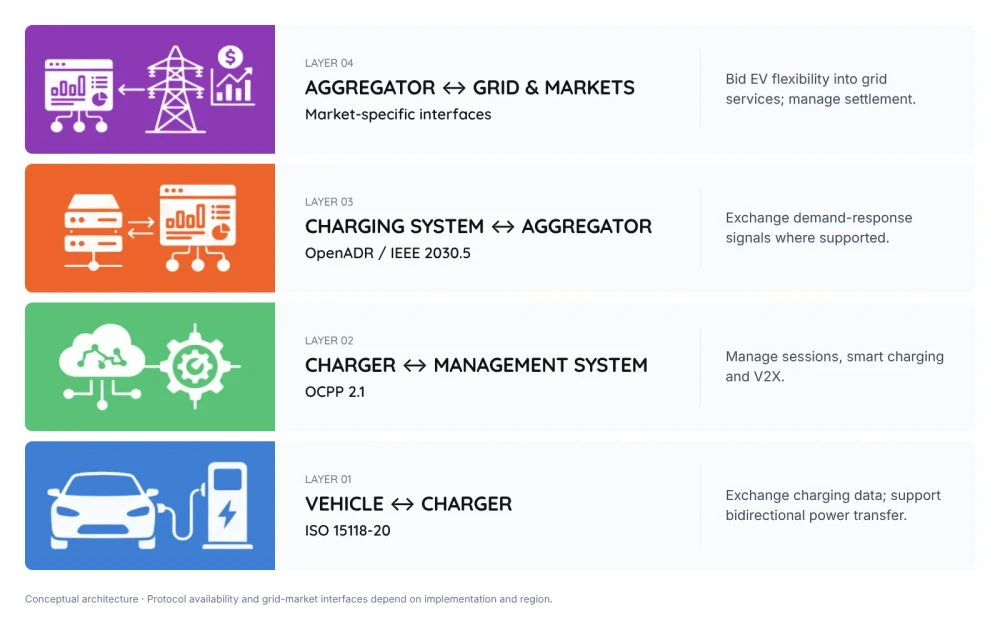
The V2G software stack: four layers
Each layer can have a different protocol, vendor and team, and all of them need to work at the same time.
Layer 1: vehicle and charger (ISO 15118-20). ISO 15118-20 defines their conversation: authentication, contract management and bidirectional power transfer. In dynamic mode, the charger and vehicle can change power during the session, which is what lets the car respond to the grid.
Layer 2: charger and management system (OCPP 2.1). Setpoints usually originate upstream. OCPP 2.1 carries charging and discharging instructions from the CPMS down to the charger and session data back up. It also supports the smart charging and V2X functions that sit between the hardware and the backend.
Layer 3: backend and aggregator (OpenADR, IEEE 2030.5 or proprietary APIs). The aggregator turns a dispersed collection of EV batteries into something a grid operator can use: a predictable, dispatchable asset with a capacity figure attached to it.
Layer 4: aggregator, grid and markets (market-specific interfaces). That asset then enters energy markets: frequency response, balancing, day-ahead and intraday trading, and settlement. Each market, country and product type may need its own integration.
One broken link anywhere in this chain, and the V2G service may stop working, even if the car still charges normally.
Where V2G runs today: the Netherlands, Germany and the UK
Commercial deployments are still concentrated in fleets and car-sharing schemes.
- Utrecht, Netherlands. We Drive Solar runs bidirectional public AC chargers across the city, and MyWheels operates the shared Renault fleet. Charging and discharging are managed automatically: the cars discharge when the grid needs support and absorb surplus solar generation.
- Dutch households. Vattenfall, Kia and Hyundai launched a six-month V2G pilot in 2026 for up to 80 households with a Kia EV9 or Hyundai IONIQ 9, bidirectional charger installation included.
- Germany. E.ON and BMW launched what they describe as Germany's first commercial V2G solution for private customers. Volkswagen's Elli is also preparing a commercial rollout.
- United Kingdom. Octopus Power Pack is a V2G add-on tariff. For a driver covering 7,500 miles a year, Octopus estimates savings of £620 a year compared with a standard variable tariff.
The pattern: fleets first, private owners next. Predicting when a private owner will need their car is difficult. Predicting when a shared car will sit idle is much easier when booking data is available, and dispatching reliably is far more tractable when vehicles are managed assets.
V2G in the UK: what is different
The UK has its own rules, so an EU V2G playbook does not transfer directly.
| Topic |
Great Britain |
European Union |
| Charging standards |
AFIR does not apply. The Smart Charge Points Regulations 2021 and Public Charge Point Regulations 2023 cover smart functionality, security, payments and reliability. |
ISO 15118-20 required from 1 January 2027 under AFIR (Delegated Regulation 2025/656) |
| Permission to export |
G98 notification up to 3.68 kW (16 A per phase); G99 approval above that, from the distribution network operator |
Set nationally by grid operators |
| Licensing of flexibility software operators |
Load control licence for load controllers and flexibility service providers under the Smart Secure Electricity Systems (SSES) programme |
Depends on the member state |
| Example commercial offer |
Octopus Power Pack |
Utrecht car-sharing (NL), E.ON and BMW (DE) |
Two UK specifics matter most for software teams.
Grid connection is site-specific data. Most bidirectional chargers export more than 3.68 kW, so they need G99 approval before export is switched on, and Octopus lists it as a condition of joining. The process has become faster: according to a Versinetic analysis, G99 approval was streamlined in 2025 and UK Power Networks now offers automatic V2G connection approval. For the backend, an approved export limit is a per-site parameter, not a constant.
Aggregators will need a licence. Under the SSES programme, organisations that control domestic smart appliances such as EV chargers will need a load control licence. The draft rules add cyber security requirements for load controllers and consumer protection duties for flexibility service providers. The government planned to open applications by the end of 2026, followed by a 12-month transition, with Ofgem running the regime. For V2G software, security and auditability become regulatory requirements, not just good practice.
The potential is large. Versinetic estimates that the UK's 2.28 million battery electric vehicles hold about 114 GWh of theoretical storage, although only a fraction will ever be available to the grid.
Why fleets go first, and what it means for depot-based logistics
Fleets are the easiest place to make V2G pay, because the software knows when the vehicles will be parked. A last-mile delivery van that returns to the depot in the evening and leaves in the morning has a long, predictable plug-in window. A depot full of electric vans is, in effect, a large battery that is idle most of the night.
UK trials are testing exactly this. In the V2VNY project, part of Innovate UK's V2X Innovation Programme, Denbighshire County Council installed an AC V2G charger at a fleet depot serving more than 400 vehicles, over 100 of them electric.
For a fleet operator, V2G is an integration problem first. Dispatch decisions need data from fleet management software: route plans, departure times and the state of charge each vehicle needs for its next shift. Get that wrong and a van leaves half-empty. Connecting telematics, depot charging and route planning is the same work that sits behind EV software in logistics generally, and it is where most of the value is. If you run a depot-based fleet, see how we approach logistics software development.
Does V2G damage EV batteries?
Not necessarily: it depends on how the software manages charging and discharging. Battery degradation is the question that comes up every time V2G is mentioned.
Geotab's analysis of more than 22,700 EVs across 21 makes and models, published in January 2026, found average battery degradation of 2.3% per year. Charging power was the strongest operational factor. Vehicles that relied heavily on DC fast charging above 100 kW degraded by up to 3.0% a year, against about 1.5% for vehicles that mostly used AC or lower-power charging. The study did not look at V2G specifically, but most V2G today runs at AC or low DC power.
Managed bidirectional charging, which respects temperature windows, avoids deep discharge and keeps the battery within its design duty cycle, may under some conditions be better for battery health than leaving the car at 90% all day. That logic sits in the battery management system and in the aggregator's dispatch algorithm. Dispatch intelligence is not only about revenue optimisation, but also about battery stewardship.
What's still missing in V2G
V2G is real, but it's not finished. Three gaps stand out.
Business models are still immature. The biggest barrier to scale is the lack of stable, predictable revenue rules that make V2G bankable for owners and aggregators alike. Even Renault's Mobilize lists tax rules, grid fees and certification among the barriers to remove.
Interoperability across borders doesn't exist yet. A TSO API integration that works in the Netherlands has to be rebuilt for Germany, and again for Great Britain. Roaming for energy is orders of magnitude harder than roaming for EV charging.
Most drivers aren't using it. Battery anxiety persists despite the data, setup is not straightforward (in the UK it includes a G99 application), and nobody has yet built an experience simple enough that a non-technical EV owner would just sign up. That's not a hardware or protocol problem, but a product problem.
Building V2G software with Happy Team
The hardware is mostly there, and the standards are catching up. The real challenge is the software that connects a parked car to an energy market: managing fleets with unpredictable availability, keeping market integrations working when TSO APIs change, and making sure the car earns money without the driver losing sleep over the battery.
Utrecht proved it can be done. Now someone needs to do it at scale.
At Happy Team, we build software for eMobility companies, from an EV charging app for one of our clients to backend integrations. If you are adding OCPP 2.1 to your CPMS, connecting chargers to an aggregator or planning V2G for a fleet, explore our eMobility solutions or contact us.
FAQ
What is V2G software? V2G software is the set of systems that decide when a parked EV charges or discharges and that settle the energy it sells. It spans the charger communication (ISO 15118-20), the Charge Point Management System (OCPP 2.1), an aggregator platform and integrations with energy markets.
Is V2G available in the UK? Yes. Octopus Energy's Power Pack is a commercial V2G tariff, and since June 2025 it has been sold as a bundle with a BYD Dolphin and a bidirectional Zaptec Pro charger. Exporting energy needs G99 approval from the local distribution network operator.
Do I need G99 approval for V2G? In most cases, yes. Export up to 3.68 kW (16 A per phase) can use the simpler G98 notification. Most bidirectional chargers export more than that, so they need G99 approval before export is switched on.
Which protocols does V2G use? ISO 15118-20 between the vehicle and the charger, OCPP 2.1 between the charger and the management system, and OpenADR, IEEE 2030.5 or proprietary APIs between the backend and the aggregator. Connections to energy markets are specific to each country and product.
Does OCPP 1.6 support V2G? Not in a standardised way. OCPP 1.6 supports smart charging, but bidirectional charging was standardised only in OCPP 2.1, released in January 2025.
Does V2G degrade the battery? Not necessarily. There is no large public dataset on V2G wear yet, but Geotab's 2026 study of 22,700 EVs found that charging power is the main driver of degradation: about 1.5% a year with AC or lower-power charging against up to 3.0% with frequent DC charging above 100 kW. Most V2G runs at low power.